Craft
The Anatomy of a Layered Lamp
From parametric sketch to print bed to living room — a 14-hour study in the slow architecture of light.
By Manthan Bhandari · 10/12/2025 · 7 min read
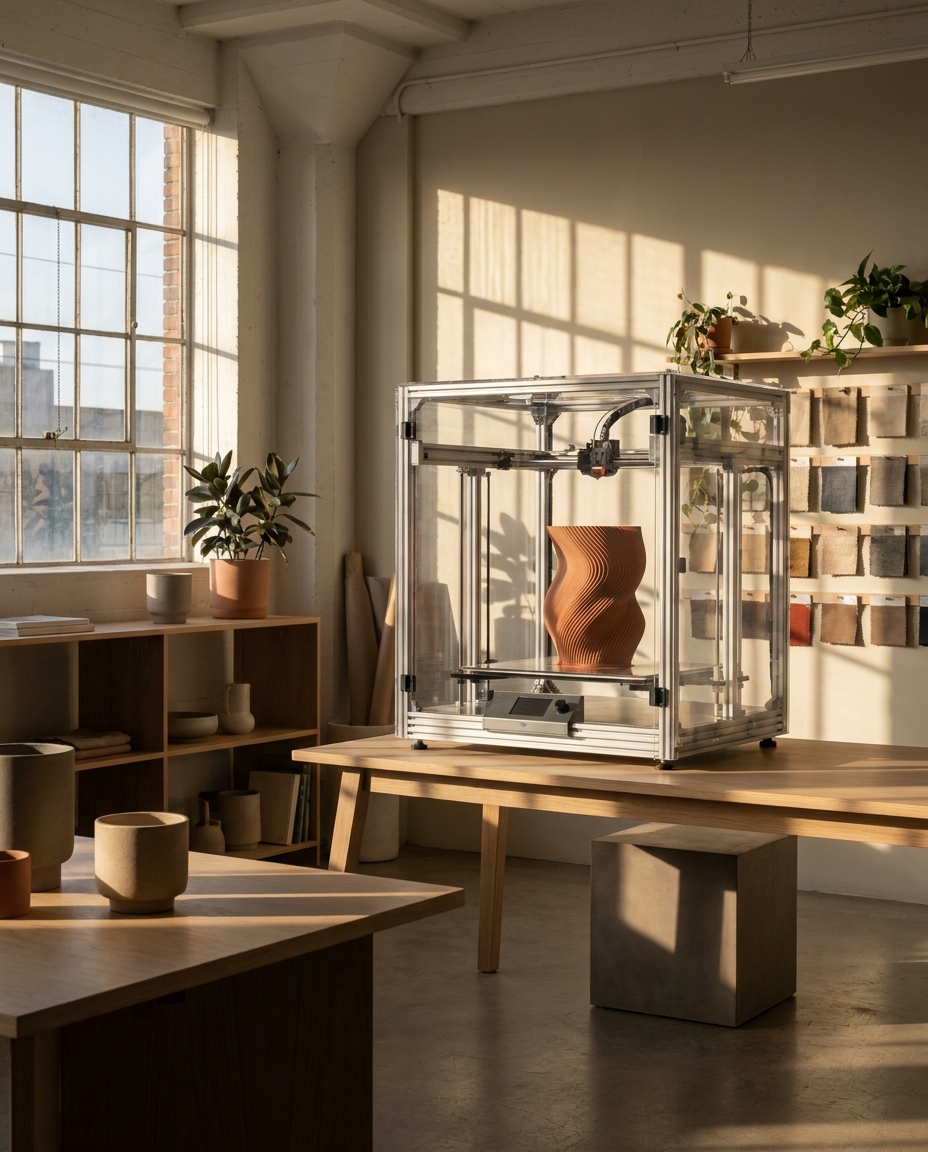
A 14-hour study
A single pendant lamp, from the moment we click "print" to the moment it ships, takes 14 hours. Of those, 9 are unattended. The printer does its work in the dark, layer by layer, in a studio in Bengaluru where the morning light still hasn't reached the second floor.
The other 5 hours are hands. Sanding, polishing, threading the brass cord, testing the bulb socket, packing in raw cotton and craft paper. The hand-finishing is not a value-add — it is the thing.
Why additive manufacturing
We are not interested in 3D printing as a novelty. We are interested in it as a *slow* industrial process — one that rewards patience over speed, and that allows a single object to exist in editions of one, or editions of fifty, without compromise.
The layer lines you see on a JAL or a TERRA are not flaws. They are the memory of the object's making. They are why a printed lamp reads as crafted, not as factory-made.
The math of light
A translucent bio-silk pendant behaves like a low-pass filter for light. It softens. It diffuses. It warms. The radiating pattern of a KIRAN does the opposite — it focuses, it casts, it draws the room into a single geometry.
We design each piece not by sketching, but by simulating. The bulb, the cord, the print orientation, the layer height — all of these are variables. The output is a slow, considered object.
More dispatches